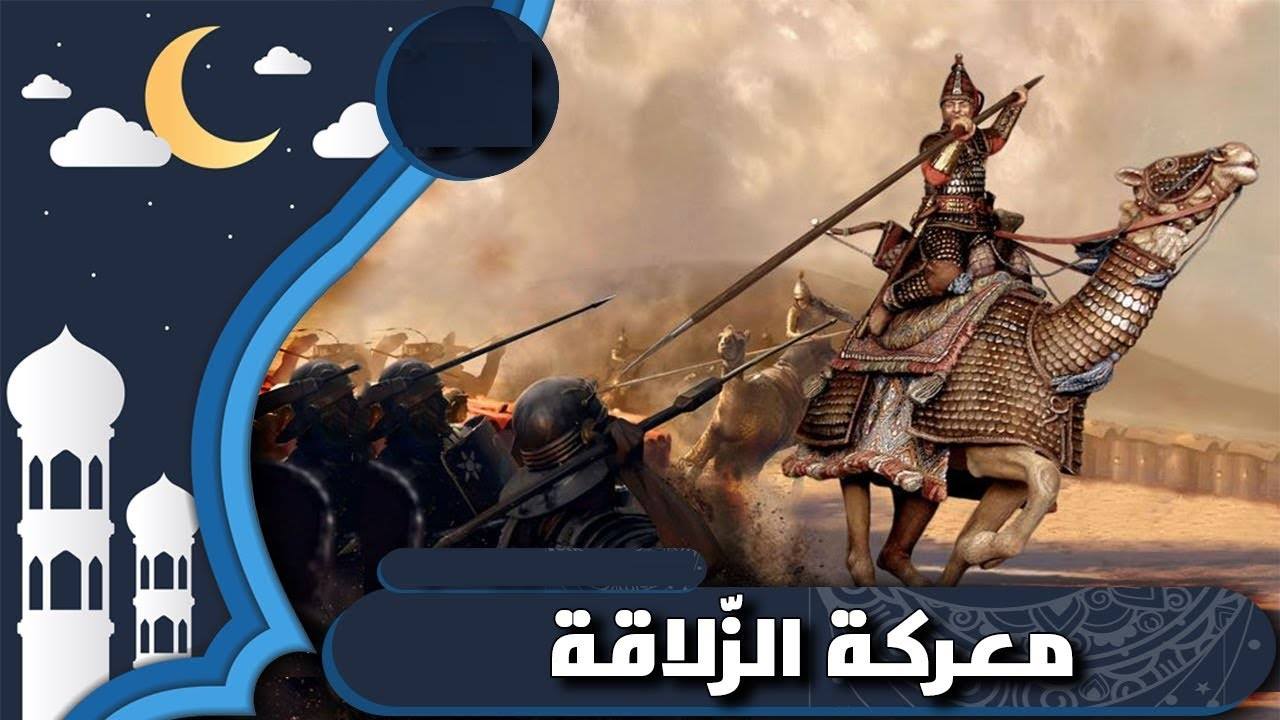
The Battle of Zallaqa, or the Battle of the Plain of Zallaqa, took place on 12 Rajab 479 AH / 23 October 1086 AD between the armies of the Almoravid state, united with the army of Al-Mu'tamid ibn Abbad, who won a crushing victory over the forces of the Castilian king Alfonso VI. The battle took place in a plain in the southern part of Andalusia called Al-Zallaqa. It is said that the plain was named after the frequent slipping of the combatants on the battlefield due to the amount of blood that was shed that day and filled the battlefield. Western historians call it by the same Arabic name. The battle had a major impact on the history of Islamic Andalusia, as it halted the steady advance of the Crusaders into the lands of the Islamic Taifa kings and delayed the fall of the Islamic state in Andalusia for more than two and a half centuries.
Pre-Battle The Umayyad state in Andalusia fell and disintegrated into what became known as the Taifa Kings period, which witnessed numerous conflicts and wars between its many kings. This weakened the position of Muslims in Andalusia, which led to military weakness and gave the opportunity to the Christians lurking in the north to expand at their expense. In contrast to the fragmentation and division of Andalusia during the Taifa era, the Christians established a union between the kingdoms of Leon and Castile at the hands of Ferdinand I, who began the Reconquista, which meant returning Andalusia to Christianity instead of Islam. This war was continued after him by his son, Alfonso VI, and reached its peak with Alfonso’s capture of Toledo in 478 AH / 1085 AD, the most important city in Andalusia and the largest Muslim base there. Its fall was a harbinger of the worst consequences for the rest of Andalusia, as Alfonso said explicitly: “He will not rest until he recovers the rest of Andalusia, subjugates Cordoba to his authority, and moves the capital of his kingdom to Toledo.” The worst thing about this horrific disaster was that the Muslim Taifa kings did not rush to the rescue or help Toledo. On the contrary, they took a shameful stance, and some of them even offered to help Alfonso, while others believed that in order to continue ruling his kingdom in peace, he must strengthen ties of friendship and support with Alfonso, form an alliance with him, and pay him annual tribute. Some of the Taifa princes’ forces even participated in the conquest of Toledo, and one of these princes offered his daughter to be a wife or concubine to Alfonso!! Alphonse VI saw the weakness and cowardice of the taifa princes, which stemmed primarily from their luxury, emptiness of souls, and hatred of war and jihad, even if it was the only way to achieve dignity and preserve the remnants of religion and chivalry. Therefore, Alphonse VI saw the need to weaken the taifa kings before eliminating them completely. His plan was to first liquidate their wealth by imposing tribute on all of them, then to destroy their lands, crops, and crops through successive raids, and finally to seize their fortresses and lands whenever the opportunity arose. Alphonse's plan was completely successful, and the weakness of the Taifa kings became clear and tangible to him. He looked down on them and despised them, saying about them: "How can I leave a people of madmen, each of whom is called by the name of their caliphs and kings, and each of whom does not draw a sword to defend himself, nor does he lift injustice or oppression from his subjects?" He treated them as followers. After Alfonso's conquest of Toledo, he became a neighbor of the Kingdom of Seville and its ruler, Al-Mu'tamid ibn Abbad. Al-Mu'tamid then realized the enormity of his mistake in reconciling with Alfonso, allying with him, and antagonizing him against the other Taifa princes. He was visibly aware of the terrible fate he would face if divine providence did not provide him with unexpected aid or support. Therefore, it was natural for Ibn Abbad to turn his attention to the young, powerful Almoravid state, led by its valiant prince, Yusuf ibn Tashfin, seeking his help and support against the Christians who had gathered from northern Spain, in addition to the Crusader volunteers who had come from France, Germany, and Italy.
The conflict between Alphonse VI and Al-Mu'tamid The conflict between the two kings began in 475 AH / 1082 AD when Alfonso sent his usual embassy to Al-Mu'tamid requesting the annual tribute. The embassy was headed by a Jew named Ibn Shalib, who refused to accept the tribute on the grounds that it was of a defective standard. He threatened that if he was not given money of a good standard, the cities of Seville would be occupied. When Al-Mu'tamid learned of what the Jew had done, he ordered him to be crucified and his Castilian companions to be imprisoned. When he consulted the jurists, they approved of this decision, fearing that Al-Mu'tamid would back down from his decision to stand up to the Christians. As for Alfonso, he was furious and sent his troops and soldiers to take revenge, plunder and loot. He and his army raided the borders of Seville and besieged it for three days, then left it. Al-Mu'tamid committed himself to defending himself throughout this raging storm of Crusader rage. Seeking help from the Almoravids Al-Mu'tamid mobilized his men, strengthened his army, repaired his forts, and adopted every means to defend his land after he realized that Alfonso intended to work to exterminate them all, and that the Muslims in Seville, with their limited capabilities and resources, would not be able to defend themselves. Therefore, Al-Mu'tamid decided to seek the help of the Almoravids in Morocco to fight these Christians. The Almoravid state was a state of jihad and war, but this opinion faced opposition from some princes who saw negotiations, reconciliation, truce, and peace as a means to security and stability. They saw the Almoravids as a new enemy who might usurp their kingdom. Al-Rashid said to his father, Al-Mu'tamid: "O my father, are you bringing into our Andalusia someone who will usurp our kingdom and scatter us?" Al-Mu'tamid replied: "O my son, by God, he will never hear that I returned Andalusia to the abode of unbelief, nor left it to the Christians, so that the curse of Islam will fall upon me, as it has upon others. By God, herding camels is better for me than herding pigs." The Taifa kings, headed by Al-Mu'tamid ibn Abbad, appealed to the Almoravids and their emir, Yusuf ibn Tashfin, to help them. Al-Mu'tamid even crossed to Morocco and met with Ibn Tashfin, who promised him good things and agreed to his request. He stipulated that in order to answer the call and cross to Andalusia, Al-Mu'tamid should hand over to him the port of Algeciras to be a base for the Almoravids on their way there and back. Al-Mu'tamid agreed to that.
Crossing to Andalusia Yusuf ibn Tashfin mustered his troops and equipment, then sent a force of his cavalry led by Dawud ibn Aisha, who crossed the sea and occupied the port of Algeciras. In Rabi` al-Akhir 479 AH / August 1086 AD, the Almoravid armies began crossing from Ceuta to Andalusia. No sooner had the ships reached the middle of the Strait of Gibraltar than the sea became turbulent and the waves rose high. Ibn Tashfin stood up and raised his hands to the sky and said: “O Allah, if you know that my crossing is good and beneficial for the Muslims, then make it easy for me to cross this sea. If not, then make it difficult for me so that I cannot cross it.” The sea calmed down and the ships sailed in a good wind until they anchored on the shore. Yusuf disembarked from them and prostrated himself to Allah. Yusuf ibn Tashfin and his soldiers were warmly received, and he ordered his commander, Dawud ibn Aisha, to advance ahead of him to Badajoz. He also ordered that all the Andalusian forces be placed under the command of Al-Mu'tamid, and that the Andalusian soldiers should have their own quarters, and the Almoravids should have their own quarters. Yusuf was very cautious in his movements, as he had never fought a Christian army before, and he did not trust his Andalusian allies. Therefore, he decided that the battle should be in the Badajoz region, and that he should not penetrate too deeply into Andalusian territory.
Al-Zallaqa and the Clear Victory When Alfonso heard the news of the Muslims' advance to meet him, he lifted the siege that he had been imposing around the city of Zaragoza, and summoned his commander, Al-Burhans, from Valencia, and sent a call for help to all the Christians in northern Spain and beyond the Pyrenees Mountains. Crusader knights flocked to him from Italy and France, and he intended to meet the Muslims in their own land so that his country would not be destroyed. His forces outnumbered the Muslims in number and equipment, and these Crusader armies settled three miles from the Muslim camp, separated from them only by a small river called “Guerrero”. The Crusader forces were joined by monks and priests carrying their Bibles and crosses, thus encouraging the Christian soldiers. The Muslim forces were estimated at about forty-eight thousand fighters, divided into two large units of Andalusian forces. The vanguard was led by Al-Mu'tamid, while the Almoravid forces occupied the rear and were divided into two sections. The first included Berber cavalry led by Dawud ibn Aisha, and the second section was a reserve, led by Yusuf ibn Tashfin. The two armies remained facing each other for three days. Alphonse's attempt to deceive the Muslims by setting a date for the battle failed. The battle ended with the outbreak of the battle at first light on Friday, Rajab 12, 479 AH / October 23, 1086 AD, with a lightning attack launched by the Crusader knights on the Muslim advance guard, which was composed of Andalusian forces. The balance of the Muslims was upset and their knights retreated towards Badajoz. Only Al-Mu'tamid ibn Abbad stood firm with a small group of knights, who fought fiercely. Al-Mu'tamid was severely wounded, and many of the Andalusian soldiers were killed, and they were almost defeated. At the same time, Alphonse attacked the Almoravid advance guard and drove them back from their positions. Faced with this ordeal that the Muslim forces were exposed to, Yusuf sent the Berber forces led by his most skilled commander, Sir ibn Abi Bakr al-Lamtoni. The course of the battle changed, the Muslims regained their composure, and inflicted heavy casualties on the Christians. Meanwhile, Ibn Tashfin resorted to an innovative plan. He was able to split the Christian ranks, reach their camp, eliminate its garrison, and set it on fire. When Alfonso saw this tragedy, he quickly retreated, and the two sides clashed in a fierce battle. The thunder of the Almoravid drums was deafening, and many were killed on both sides, especially among the Castilians. Then Ibn Tashfin dealt his final blow to the Christians. He ordered his Black Guard, four thousand fighters of great courage and a desire for jihad, to descend to the battlefield. They killed many Castilians, and one of them was able to stab Alfonso in the thigh, a stab that nearly cost him his life. Alphonse realized that he and his forces were facing death if they continued the battle, so he took the initiative to flee with a few of his knights under the cover of darkness. They did not exceed four hundred, most of whom were wounded and died on the way. Only one hundred knights survived.
After victory The Muslim victory at Zallaqa was a great victory, the news of which spread throughout Andalusia and Morocco, and the Muslims were greatly encouraged by it. However, the Muslims did not try to exploit their victory by pursuing the remaining Christian remnants and marching into the lands of Castile. They did not even attempt to march to Toledo to reclaim it, which was the main reason for seeking help from the Almoravids. It is said that Ibn Tashfin apologized for pursuing the Castilians after he received news of the death of his eldest son. This decisive battle resulted in the Taifa kings ceasing to pay tribute to Alfonso VI. This victory saved western Andalusia from devastating raids, caused the Castilians to lose a large number of their forces, revived the hopes of the Andalusians and shattered their fear of the Christians. It lifted the siege of Zaragoza, which was about to fall into the hands of Alfonso. This battle prevented the entirety of Andalusia from falling into the hands of the Christians, and extended the life of Islam in Andalusia by about two and a half centuries.
After the victory, the Andalusians resumed their pre-battle tactics: fighting among themselves, vying for power, and seeking the aid of Christian kings in their wars against one another. Ibn Tashfin then invaded Andalusia to put an end to the strife and unite it under his rule.
Why We Were Great Unforgettable Days: Important Pages of Islamic History by Tamer Badr

 EN
EN  AR
AR  FR
FR  ES
ES  PT
PT  DE
DE  IT
IT  PL
PL  SV
SV  NB
NB  FI
FI  NL
NL  DA
DA  CS
CS  SK
SK  ET
ET  LV
LV  LT
LT  RU
RU  BE
BE  UK
UK  HU
HU  BG
BG  RO
RO  SR
SR  HR
HR  BS
BS  SQ
SQ  EL
EL  TR
TR  HE
HE  ZH
ZH  JA
JA  KO
KO  ID
ID  MS
MS  VI
VI  TL
TL  TH
TH  MY
MY  KM
KM  HI
HI  UR
UR  BN
BN  FA
FA  PS
PS  KK
KK  UZ
UZ  HY
HY  KA
KA  TA
TA  NE
NE  SI
SI  SW
SW  AM
AM