The approximate number of dead and dying during the time of the Hour of Troubles
Mike Rampino, a geologist at New York University, and Stanley Ambrose, an anthropologist at the University of Illinois, believe that the last population bottleneck experienced by the human race was the result of the Toba supervolcano explosion. They believe that the conditions following that explosion were comparable to the aftermath of a full-scale nuclear war, but without radiation. The billions of tonnes of sulphuric acid that rose into the stratosphere following the Toba disaster plunged the world into darkness and frost for several years, and photosynthesis may have slowed to a crawl. Photosynthesis slowed to a near standstill, destroying food sources for both humans and the animals that feed on them. With the advent of the volcanic winter, our ancestors starved and died, and their numbers gradually declined, perhaps in protected areas (for geographical or climatic reasons). One of the worst things that has been said about this catastrophe is that for about 20,000 years, there were only a few thousand humans on the entire planet, meaning that our species was close to extinction, and if this is true, it means that our ancestors are just as endangered as they are today Despite all odds, the remnants of our species seem to have succeeded in their struggle for survival in the aftermath of the Toba disaster and the onset of the Ice Age, and we now number more than seven and a half billion people (a billion equals a thousand million), of which about 1. 8 billion are Muslims.In order to calculate the death toll after five massive natural disasters (such as the Toba supervolcano eruption) that will happen to the globe, we must first calculate the current population of the world.
World population now:
According to United Nations estimates, the global population will reach more than seven and a half billion in 2020, and is expected to increase by two billion people in the next 30 years, meaning that the world's population will increase from 7.7 billion today to 9.7 billion by 2050, and 11 billion by 2100. 61% of the world's population lives in Asia (4.7 billion), 17 per cent in Africa (1.3 billion), 10 per cent in Europe (750 million), 8 per cent in Latin America and the Caribbean (650 million), and the remaining 5 per cent in North America (370 million) and Oceania (43 million). China (1.44 billion) and India (1.39 billion) remain the world's largest countries. The world's 7.7 billion people now live in 148.9 million square kilometres of land area, the part of the Earth's crust that is not covered by water.
Here we come to the habitable space that the human race will end up staying in: the Levant: The area of the Levant, which currently includes four countries, namely: Lebanon, Palestine, Syria, Jordan, and some of the territories formed from its lands, such as: Turkey's northern Syrian provinces, Egypt's Sinai Desert, Saudi Arabia's Al-Jawf and Tabuk regions, and Iraq's Mosul, all of this area does not exceed about 500,000 square kilometres at the most, and a population of no more than 100 million people live in all of these areas at the most. This same area with the same natural resources will accommodate the last generations of humanity before the end of time, knowing that this is the only place suitable for life that is self-sufficient in its natural resources, i.e. there is no such thing as importing from abroad. The humans who will reside in the Levant at the end of time will depend entirely on the natural resources of water, agriculture, mining and all the various resources that humans need in order to survive.
The question now is whether the Levant can accommodate seven billion people without the need for the outside world.
Of course, the answer will be no. The number of the Levant's population is about 100 million people who import part of their various resources from different parts of the world, but we will go a little beyond this figure and say that the Levant can accommodate 500 million people in an area of about 500 square kilometres, meaning that the population density will be about 100 individuals per square kilometre, which exceeds the population density of an overpopulated, resource-poor country like Bangladesh, for example.
These are the approximate figures for the number of people who will remain in the world after the occurrence of five huge natural disasters and an unknown number of medium and small natural disasters. If the countdown to the Hour of Judgement begins now, and the world has a population of about seven and a half billion people, its population will reach about five hundred million people after at least three centuries, as mentioned earlier, at the maximum scientific estimate.
The question now is: Where are the remaining seven billion people?
The answer: They are dead and dying due to successive natural disasters in a time span of at least three centuries!
Do you, dear reader, understand the number I mentioned to you, it is almost seven billion people, which is a number that exceeds the population of India by almost seven times, all of these people will be dead within three centuries or more, and there will be only 500 million living human beings left on the planet Earth at the most, where they will be located in an area that does not exceed 500,000 square kilometres in the country of the Levant, and this number is exaggerated, as the Levant, with its resources, water and farms, will not be able to absorb half a billion people. This figure is exaggerated, as the Levant, with its resources, water and farms, will not accommodate half a billion people, but I put this figure, which is the maximum imaginable by the human mind, in order to conclude that seven billion people will be dead, missing and dead for at least three centuries, if we are now in the year 2020 and during the Dhimmiya Fitnah, at the end of which the Mahdi will appear. at the end of which the Mahdi will appear, and thus the massive volcano that will cause the visible smoke will explode at the end of that fitna, but if the timing of the countdown to the Shariat of the Hour is different and these events begin in 2050, for example, the same numbers of people that we mentioned will remain alive in the Levant, about half a billion at most, but then the numbers of the dead and dying will differ. If the countdown to the Shari'at al-Haramat al-Sharqat al-Haram begins in 2100, the number of dead and dying will reach almost eleven billion people, and so you can count the number of dead and dying at any time from the first of the great disasters, the smoke, to the last of these huge disasters, the eruption of the volcano of Eden.
Do the necessary calculations to roughly estimate the number of human deaths after each of the five natural disasters (the first supervolcano, the eastern calamity, the Moroccan calamity, the Arabian Peninsula calamity, and the volcano of Aden). There is no American science fiction film that depicts disasters similar to the natural disasters mentioned in this book, except for one American film that roughly imagines these disasters: the 2009 film (2012). The number of deaths we have mentioned, which will amount to billions of human beings, brings us to the hadith narrated by al-Bukhari in his Sahih on the authority of Awf bin Malik (may Allah be pleased with him), who said: "I came to the Prophet (peace be upon him) during the Battle of Tubuk while he was in an adam dome, and he said: 'Count six things between the two hands of the Hour: My death, then the conquest of the House of Jerusalem, then a death that will take among you like sheep flocks, then an abundance of wealth until a man is given a hundred dinars and he remains dissatisfied, then a calamity that will leave no house of the Arabs untouched. a house of the Arabs but it will enter it, then a truce will be between you and the Children of the Yellow, and they will betray you, and they will come to you under eighty gates, under each gates will be twelve thousand." The scholars have interpreted "a death that will take among you like the flocks of sheep" as the plague that occurred during the time of 'Umar bin al-Khattab (may Allah be pleased with him) after the conquest of Jerusalem (in 16 AH), where the plague disease spread in the year (18 AH). A large number of people died, including Mu'adh bin Jabal, Abu Ubaidah, Sharhbil bin Hasanah, al-Fadl bin al-Abbas bin Abdul-Muttalib and others, may Allah be pleased with them all.
But I tell you, after an approximate count of the number of dead, missing and dead people during the time of the Shariat of the Hour, that the interpretation of this hadith applies to what will happen later and has not happened yet, as the 25,000 who died in that epidemic are a negligible number next to the approximately 7 billion people who will die during the time of the Shariat of the Hour, and the Prophet's description of the disease that will cause these deaths is (like a sheep's calf). Also, the Prophet's description of the disease that will cause this death, which is a disease that takes the animals and something comes out of their noses and they die suddenly, is similar to the symptoms that will be caused by the smoke from the eruption of the supervolcano, and God knows best.
Is it not worthy that God Almighty should send a messenger to the inhabitants of the earth, who number about seven and a half billion, to warn them of His punishment before it falls on them, in accordance with His words in Surah Al-Israa': "Whoever is guided, he is guided for himself; and whoever goes astray, he goes astray for himself; and there is no one to bear another's weight.
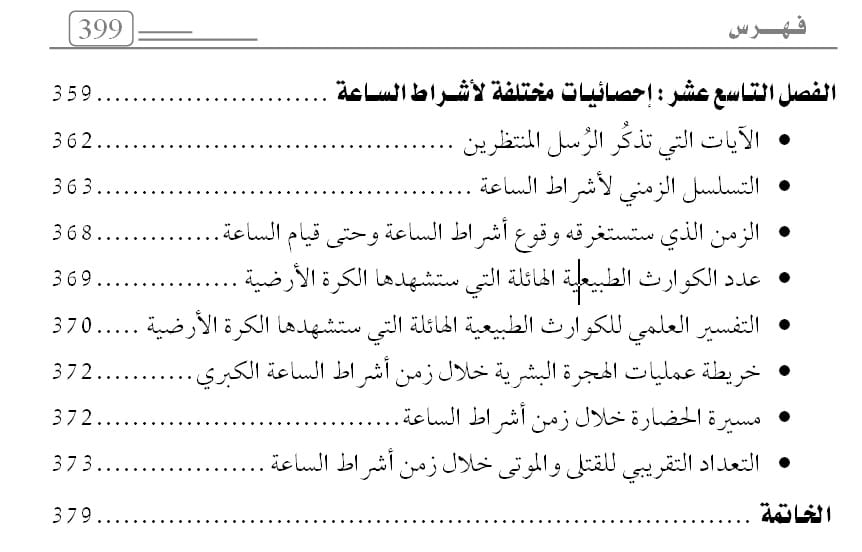
(End quote from part of the nineteenth chapter of The Awaited Letters)

 EN
EN  AR
AR  FR
FR  ES
ES  PT
PT  DE
DE  IT
IT  PL
PL  SV
SV  NB
NB  FI
FI  NL
NL  DA
DA  CS
CS  SK
SK  ET
ET  LV
LV  LT
LT  RU
RU  BE
BE  UK
UK  HU
HU  BG
BG  RO
RO  SR
SR  HR
HR  BS
BS  SQ
SQ  EL
EL  TR
TR  HE
HE  ZH
ZH  JA
JA  KO
KO  ID
ID  MS
MS  VI
VI  TL
TL  TH
TH  MY
MY  KM
KM  HI
HI  UR
UR  BN
BN  FA
FA  PS
PS  KK
KK  UZ
UZ  HY
HY  KA
KA  TA
TA  NE
NE  SI
SI  SW
SW  AM
AM