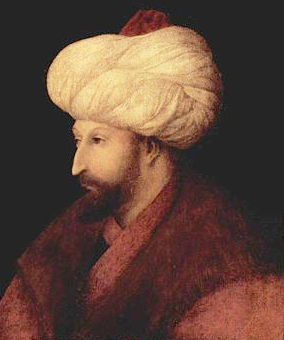
Sultan Mehmed II the Conqueror, also known as Fatih Sultan Mehmed Khan II, was the seventh sultan of the Ottoman Empire and the Ottoman dynasty. He was also known as Abu al-Futuh and Abu al-Khairat, in addition to “the Conqueror.” After the conquest of Constantinople, the title “Caesar” was added to his titles and those of the other sultans who followed him. This sultan is known for having finally put an end to the Byzantine Empire after it had lasted for more than eleven centuries. He ruled for nearly thirty years, during which Sultan Mehmed continued his conquests in Asia, unifying the Anatolian kingdoms and penetrating Europe as far as Belgrade. One of his most notable administrative achievements was the integration of the old Byzantine administrations into the expanding Ottoman Empire. His birth and upbringing Mehmed II was born on the 27th of Rajab 835 AH / March 30, 1432 AD in Edirne, the capital of the Ottoman Empire at the time. He was raised by his father, Sultan Murad II, the seventh Sultan of the Ottoman Empire, who provided him with care and education to make him worthy of the sultanate and its responsibilities. He memorized the Quran, read the Hadith, learned jurisprudence, and studied mathematics, astronomy, and military matters. In addition, he learned Arabic, Persian, Latin, and Greek. His father entrusted him with the Emirate of Magnesia when he was still young, to train him to manage the affairs of the state and administer its affairs, under the supervision of a group of prominent scholars of his time, such as Sheikh Aq Shams al-Din and Mulla al-Kurani. This influenced the formation of the young prince's personality and shaped his intellectual and cultural orientations in a true Islamic manner. The role of Sheikh “Aq Shams al-Din” was prominent in shaping the personality of Muhammad al-Fatih, and he instilled in him two matters from a young age: doubling the Ottoman jihad movement, and always suggesting to Muhammad from a young age that he was the prince meant by the prophetic hadith mentioned in Musnad Ahmad ibn Hanbal in hadith number 18189: Abdullah ibn Muhammad ibn Abi Shaybah told us, and I heard it from Abdullah ibn Muhammad ibn Abi Shaybah, he said Zayd ibn al-Hubab told us, he said al-Walid ibn al-Mughirah al-Ma’afiri told me, he said Abdullah ibn Bishr Al-Khath'ami, on the authority of his father, said that he heard the Prophet, may God bless him and grant him peace, say: "Constantinople will be conquered, and what an excellent leader its leader will be, and what an excellent army that army will be." Therefore, the conqueror hoped that the hadith of the Prophet of Islam would apply to him. He grew up ambitious, ambitious, well-educated, sensitive and emotional, a literary poet, in addition to his knowledge of the affairs of war and politics. He participated with his father, Sultan Murad, in his wars and conquests. took over the rule Mehmed the Conqueror assumed the sultanate after the death of his father on the 5th of Muharram 855 AH / February 7, 1451 AD. He began preparing to conquer Constantinople, to fulfill his dream and to be the target of the prophetic good news. At the same time, he facilitated the conquests of his young state in the Balkan region, and made his country uninterrupted, so that no enemy could lie in wait for it. Among the most prominent preparations he made for this blessed conquest was the installation of giant cannons that Europe had never seen before. He also built new ships in the Sea of Marmara to block the Dardanelles. He also constructed a large fortress on the European side of the Bosphorus, known as Rumeli Hisarı, to control the Bosphorus Strait. Conquest of Constantinople After the Sultan had completed all the necessary means to conquer Constantinople, he marched with his army of 265,000 infantry and cavalry, accompanied by huge cannons, and headed to Constantinople. At dawn on Tuesday, the 20th of Jumada al-Ula 857 AH / May 29, 1453 AD, the forces of Muhammad al-Fatih succeeded in storming the walls of Constantinople, in one of the rare military operations in history. From that time, Sultan Muhammad II was given the title Muhammad al-Fatih, and it prevailed over him, so he became known only by this name. When he entered the city, he dismounted from his horse, prostrated to God in gratitude, then headed to the Hagia Sophia Church, and ordered it to be converted into a mosque. He also ordered the construction of a mosque on the site of the grave of the great companion Abu Ayyub al-Ansari, who was among the ranks of the first attempt to conquer the ancient city. He decided to make Constantinople the capital of his state, and named it Islam Bol, meaning the House of Islam. Later, it was distorted and became known as Istanbul. He adopted a tolerant policy with the city’s residents, and guaranteed them the practice of their worship in complete freedom. He allowed those who left the city during the siege to return to their homes. Completion of the conquests After completing this conquest, which Mehmed II achieved while he was still a young man, not yet twenty-five years old, he turned to completing the conquests in the Balkans. He conquered Serbia in 863 AH / 1459 AD, the Peloponnese in Greece in 865 AH / 1460 AD, Wallachia and Bogdan (Romania) in 866 AH / 1462 AD, Albania between 867 and 884 AH / 1463 and 1479 AD, and Bosnia and Herzegovina between 867 and 870 AH / 1463 and 1465 AD. He entered into a war with Hungary in 881 AH / 1476 AD, and his sights turned to Asia Minor, so he conquered Trabzon in 866 AH / 1461 AD. One of Mehmed the Conqueror’s goals was to become the emperor of Rome and to gather new glory, in addition to conquering Constantinople, the capital of the Byzantine Empire. In order to achieve this ambitious hope, he had to conquer Italy. For this, he prepared his equipment and equipped a great fleet. He was able to land his forces and a large number of his cannons near the city of “Otranto”. These forces succeeded in capturing its castle, in Jumada al-Ula 885 AH / July 1480 AD. Muhammad al-Fatih intended to make that city a base from which to advance northwards in the Italian Peninsula, until he reached Rome, but death came to him on the 4th of Rabi` al-Awwal 886 AH / May 3, 1481 AD. Muhammad al-Fatih, statesman and patron of civilization Mehmed the Conqueror's most notable achievements were not the battlefields and wars he waged during his thirty-year reign, as the Ottoman Empire expanded to unprecedented proportions. Rather, he was a statesman of the highest caliber. In collaboration with the Grand Vizier Karamanli Mehmed Pasha and his secretary, Leyszade Mehmed Çelebi, he was able to draft the constitution bearing his name. Its basic principles remained in effect in the Ottoman Empire until 1255 AH/1839 AD. Mehmed the Conqueror was known as a patron of civilization and literature. He was a distinguished poet with a collection of poems. The German orientalist J. Jacob published his poems in Berlin in 1322 AH / 1904 AD. The Conqueror was devoted to reading and consuming literature and poetry, and he kept company with scholars and poets, selecting some of them and appointing them to ministerial positions. Due to his passion for poetry, he commissioned the poet Shahdi to compose an epic poem depicting Ottoman history, similar to the Shahnameh by Ferdowsi. Whenever he heard of a prominent scholar in a particular field, he offered him financial aid or even invited him to his country to benefit from his knowledge, as he did with the great astronomer Ali Qushji Samarqandi. Each year, he would send large sums of money to the Indian poet Khwaja Jahan and the Persian poet Abd al-Rahman Jabi. Mehmed the Conqueror brought painters from Italy to the Sultan's palace to create some artistic paintings and train some Ottomans in this art. Although the conqueror was preoccupied with jihad, he was also concerned with reconstruction and the construction of fine buildings. During his reign, more than three hundred mosques were built, including 192 mosques and congregational mosques in Istanbul alone, in addition to 57 schools and institutes, and 59 baths. Among its most famous architectural monuments are the Sultan Mehmed Mosque, the Abu Ayyub al-Ansari Mosque, and the Topkapi Palace. The conqueror was a Muslim committed to the provisions of Islamic law, pious and devout thanks to the upbringing he received, which greatly influenced him. His military conduct was a civilized conduct that Europe had not witnessed in its Middle Ages and had not known before in its law. His death In the spring of 886 AH / 1481 AD, Sultan Mehmed the Conqueror left Constantinople at the head of a large army. Before his departure, Sultan Mehmed the Conqueror had suffered from a health problem, but he ignored it due to his intense love for jihad and his constant longing for conquest. He set out leading his army himself. It was his habit to find relief from his ailments in engaging in battles. However, his illness worsened this time and became more severe, so he called for doctors. However, fate overtook him quickly, and neither treatment nor medicine worked. Sultan Mehmed the Conqueror died in the midst of his army on Thursday, the fourth of Rabi` al-Awwal 886 AH / May 3, 1481 AD. He was fifty-two years old, after ruling for thirty-one years. No one knew exactly where the conquering Sultan would head with his army, and speculations abounded. Was he headed to Rhodes to conquer the island, which had been resisted by his commander, Mesih Pasha? Or was he preparing to join his victorious army in southern Italy and then march on Rome, northern Italy, France, and Spain? This remained a secret that Al-Fateh kept to himself and did not reveal to anyone, and then death took it away. It was the conqueror's habit to keep his direction secret and leave his enemies in the dark and confused, no one knowing when the next blow would strike. He would then follow this extreme secrecy with lightning speed in execution, leaving his enemy no room to prepare and get ready. Once, a judge asked him where he was heading with his armies, and the conqueror replied, "If I had a hair on my beard to know that, I would pluck it out and throw it into the fire." One of the goals of the conqueror was to extend the Islamic conquests from southern Italy to its northernmost point, and then to continue his conquests to France, Spain, and the countries, peoples, and nations beyond them. It is said that Sultan Mehmed the Conqueror was poisoned by his personal physician, Yakub Pasha, after the Venetians urged him to assassinate him. Yakub was not a Muslim at birth, having been born in Italy. He claimed to have converted to Islam and gradually began to poison the Sultan, but when he learned of the campaign, he increased the dosage until the Sultan died. He spent his reign in continuous wars of conquest, strengthening and developing the state, during which he fulfilled the goals of his ancestors, conquering Constantinople and all the kingdoms and regions of Asia Minor, Serbia, Bosnia, Albania and the Morea. He also achieved many internal administrative accomplishments that prospered his state and paved the way for subsequent sultans to focus on expanding the state and conquering new regions. Yaqub's secret was later exposed, and the sultan's guards executed him. News of the sultan's death reached Venice 16 days later, in a political letter sent to the Venetian embassy in Constantinople. The letter contained the following sentence: "The great eagle has died." The news spread through Venice and then to the rest of Europe, and churches across Europe began to ring their bells for three days, at the Pope's command. The Sultan was buried in a special tomb he had built in one of the mosques he had founded in Istanbul, leaving behind an impressive reputation in both the Islamic and Christian worlds. Muhammad al-Fatih's will before his death Mehmed the Conqueror's will to his son Bayezid II on his deathbed is a true expression of his approach to life, and the values and principles he believed in and hoped his successors would follow. He said in it: "Here I am dying, but I am not sorry to leave behind a successor like you. Be just, good and merciful, extend your protection to your subjects without discrimination, and work to spread the Islamic religion, for this is the duty of kings on earth. Prioritize concern for religious matters above all else, and do not slacken in adhering to it. Do not employ people who do not care about religion, do not avoid major sins and indulge in obscenity. Avoid corrupting innovations, and distance yourself from those who incite you to them. Expand the country through jihad and protect the public treasury's funds from being dissipated. Do not extend your hand to the money of any of your subjects except in accordance with the right of Islam. Guarantee the livelihood of the needy, and give your honor to those who deserve it." Since scholars are the power that pervades the body of the state, honor and encourage them. If you hear of one of them in another country, bring him to you and honor him with money. Beware, beware, do not be deceived by money or soldiers. Beware of alienating the people of Sharia from your door, and beware of inclining toward any action that contradicts the rulings of Sharia, for religion is our goal, and guidance is our method, and with that we are victorious. Take this lesson from me: I came to this country as a small ant, and God Almighty gave me these great blessings. So adhere to my path, follow my example, and work to strengthen this religion and respect its people. Do not spend the state’s money on luxury or entertainment, and do not spend more than necessary, because that is one of the greatest causes of destruction.”
From the book Unforgettable Leaders by Major Tamer Badr

 EN
EN  AR
AR  FR
FR  ES
ES  PT
PT  DE
DE  IT
IT  PL
PL  SV
SV  NB
NB  FI
FI  NL
NL  DA
DA  CS
CS  SK
SK  ET
ET  LV
LV  LT
LT  RU
RU  BE
BE  UK
UK  HU
HU  BG
BG  RO
RO  SR
SR  HR
HR  BS
BS  SQ
SQ  EL
EL  TR
TR  HE
HE  ZH
ZH  JA
JA  KO
KO  ID
ID  MS
MS  VI
VI  TL
TL  TH
TH  MY
MY  KM
KM  HI
HI  UR
UR  BN
BN  FA
FA  PS
PS  KK
KK  UZ
UZ  HY
HY  KA
KA  TA
TA  NE
NE  SI
SI  SW
SW  AM
AM