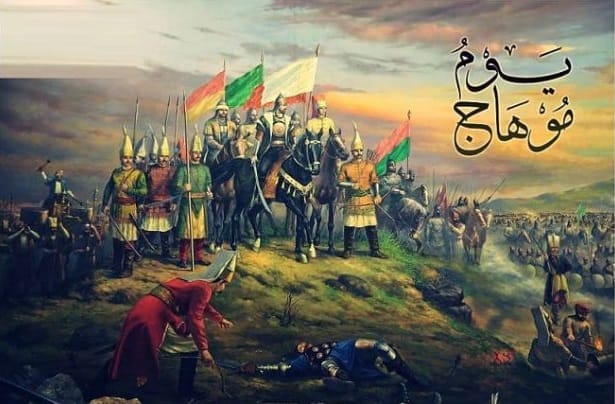
The Battle of Mohács took place in the year 932 AH/1526 AD between the Ottoman Caliphate, led by Suleiman the Magnificent, and the Kingdom of Hungary, led by Vilad Isaslav II Jaglio. The Muslims won a crushing victory, which led to Hungary being annexed to the Ottoman Empire.
Causes of the Battle of Mohacs
King Viladiusz II Jagiello of Hungary was determined to break any pledges given by his predecessors to the Ottoman Sultans, and went so far as to kill Sultan Suleiman's envoy to him. The envoy was demanding the annual tribute imposed on Hungary, and Suleiman responded with a major invasion against Hungary.
Move to the Battle of Mohacs
Sultan Suleiman marched from Istanbul on (11 Rajab 932 AH/23 April 1526 AD) at the head of his army, which consisted of about one hundred thousand soldiers, three hundred cannons and eight hundred ships, until he reached Belgrade. Then he was able to cross the Tuna River easily and smoothly, thanks to the large bridges that were constructed.
After the Ottoman army had opened several military fortresses on the Tuna River, it reached the Mohács Valley 128 days after the campaign had started, covering a thousand kilometers of march. This valley is now located in southern Hungary, 185 km northwest of Belgrade, and 170 km south of Budapest. The Hungarian army, which numbered about two hundred thousand soldiers, including 38 thousand auxiliary units that came from Germany, was waiting for it. This huge army was led by King Vlad Isaslav II Jaglio.
The expected meeting
On the morning of the encounter (21 Dhu al-Qi'dah 932 AH/29 August 1526 AD), Sultan Suleiman entered the ranks of the soldiers after the dawn prayer and delivered an eloquent and rousing sermon, urging them to be patient and steadfast. Then he entered the ranks of the Thunderbolt Corps and delivered a rousing speech that stirred morale and sharpened resolve. Among the things he said to them was: "The spirit of the Messenger of God is watching you." The soldiers could not hold back their tears, which flowed in response to what the Sultan had said.
In the afternoon, the Hungarians attacked the Ottoman army, which was lined up in three rows. The Sultan, with his mighty cannons and Janissary soldiers, was in the third row. When the Hungarian cavalry, who were famous for their bravery and courage, attacked, the Sultan ordered his first rows to retreat so that the Hungarians could rush inwards. When they reached close to the cannons, the Sultan ordered them to open fire on them.
So they reaped them, and the war lasted for an hour and a half, at the end of which the Hungarian army became a legacy of history, after most of its soldiers drowned in the swamps of the Mohács Valley, along with King Vilad Isaslav II Jagló, seven bishops, and all the great leaders. Twenty-five thousand were captured, while the Ottoman losses were one hundred and fifty martyrs and several thousand wounded.
Results of the Battle of Mohacs
The Battle of Mohács was a rare battle in history, in which one side was defeated in such a manner in a single encounter, within a short time of no more than two hours. Hungary's independence was lost after its army suffered such a devastating defeat. Two days after the encounter, on 23 Dhu al-Qi'dah 932 AH/31 August 1526 AD, the Ottoman army paraded before Sultan Suleiman, saluting and congratulating him. The commanders, starting with the Grand Vizier, kissed the Sultan's hand.
Then the army moved north along the western coast of Tuna, until it reached Budapest, the capital of Hungary, and entered it on (3 Dhu al-Hijjah 932 AH / 10 September 1526 AD). Fate willed that he would receive Eid al-Adha greetings in this city at the king’s palace, and he had celebrated Eid al-Fitr in Belgrade during his victorious campaign.
The Sultan stayed in the city for thirteen days, organizing its affairs. He appointed Jan Szapolya, Prince of Transylvania, as King of Hungary, which had become subject to the Ottoman Empire. The Sultan returned to his country's capital after Hungary had become part of the Ottoman Empire.
Why We Were Great Unforgettable Days: Important Pages of Islamic History by Tamer Badr

 EN
EN  AR
AR  FR
FR  ES
ES  PT
PT  DE
DE  IT
IT  PL
PL  SV
SV  NB
NB  FI
FI  NL
NL  DA
DA  CS
CS  SK
SK  ET
ET  LV
LV  LT
LT  RU
RU  BE
BE  UK
UK  HU
HU  BG
BG  RO
RO  SR
SR  HR
HR  BS
BS  SQ
SQ  EL
EL  TR
TR  HE
HE  ZH
ZH  JA
JA  KO
KO  ID
ID  MS
MS  VI
VI  TL
TL  TH
TH  MY
MY  KM
KM  HI
HI  UR
UR  BN
BN  FA
FA  PS
PS  KK
KK  UZ
UZ  HY
HY  KA
KA  TA
TA  NE
NE  SI
SI  SW
SW  AM
AM